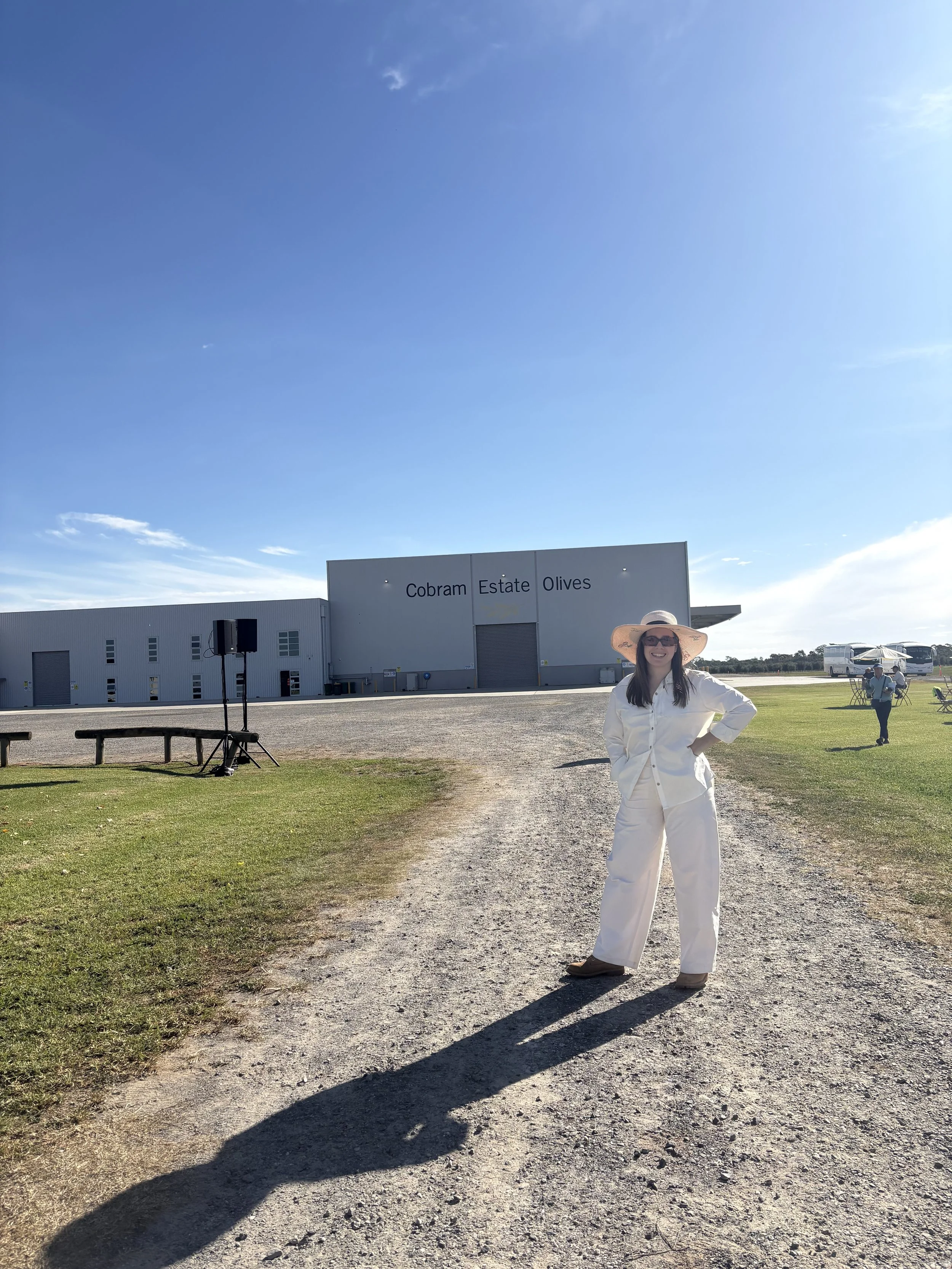
Is harvesting our performance that different to harvesting Olives?
Written by Melbourne based Life coach Jilly Reesby.
I attended Cobram Estate Olives’ olive grove in Boort Victoria a few months back for the Shareholder Day and I had a thought. Could people reach their full potential, and squeeze the most out of each drop if they were treated the way Cobram treats their olives?
As the Joint-CEO of Cobram Estate Olives Limited, Sam Beaton spoke to us on the tour about their dedication to quality and efficiency, whilst naturally supporting productivity and sustainability, I couldn’t help but hear the metaphor’s that were dangling off the trees like plump olives waiting to be harvested and extracted like liquid gold. So here is what I’m walking away with, in addition to a stunning bottle of the finest ‘First Harvest’ batch extra virgin olive oil.
SPEED OF HARVEST
When the harvest machines or ‘tree shakers’ go too slow, and catch every single olive, it drags out productivity and takes too long. When it goes too fast - it misses a huge percentage of olives, and has a higher chance of damaging the olive trees. It makes you wonder why you even ran the machine past the crop in the first place - if it’s going to take you time and effort to back track and do the whole harvest again. There is a sweet spot, somewhere in between these two approaches for harvesting their olives.
It’s not that different to humans and the way we tend to work, there really can be such blindness to the polarities of these working styles, completely missing the change to work in the sweet spot.
TOO SLOW
When we don’t have enough work on, or we’re going ‘too slow’ it’s like an unproductive harvest - we’re unmotivated and it’s hard to get anything done, because we aren’t challenged at all or we have to go through too many levels of approval to make change - we’re not learning anything new or solving anything. We’re being too precise and collecting and analysing (and tripping over) every teeny-tiny detail. The perfectionists approach means we don’t have any sense of gratification that comes with progress or momentum - we feel like this project or process will take forever and it’s hard to see the finish line.
TOO FAST
When we’re pushed too hard to deliver or going ‘too fast’, key components of a project that make up good quality work, like taking the big picture view on decisions and impacts can be missed, which make us have to start again, and re-do the entire process or project to pick up a good bulk of the work skipped, missed or forgotten in the mayhem of busyness. We haven’t actually solved anything meaningful or with real integrity. It can seriously undermine outcomes - projects fall short, or deadlines get rushed just to tick a box, without addressing anything of real substance. In the end, it’s little more than surface-level, superficial work that gives the appearance of progress without delivering anything truly valuable.
SWEET SPOT
Again there is that sweet spot with work where you have a good sense of momentum, a healthy dose of autonomy and decision making power to feel connected to and empowered in your role. You’re not just one person on a tractor. You’re contributing to the eco-system and understand how it all supports the bigger picture goals.
Questions:
Think back to your favourite, best project or career chapter, what is the pace that you harvested your best work?
Now think back to the worst, and reflect on that harvest pace?
What will you now do with these new insights? Do you need to make any changes to your pace?
“ON” and “OFF” HARVESTS
The timing in which you can harvest is obviously important too. I find it so interesting that olive trees have a biological pattern called alternate bearing, also known as “on” and “off” years. This means one year it’s gang busters and fruiting very well, and the following year will produce a smaller crop because it’s focusing on conserving it’s energy and recovering rebuilding it’s reserves. I’m sure very quickly you can already recall a year where you felt more “off” than “on”.
Consider whether you’re in an “on” or “off” year before we say YES to a big project, promotion or opportunity to expand ourselves in a role at work.
We blindly say yes to leading others when we’re dealing with too much at home, or are coming off the back of a huge project but you don’t even have the energy to deal with the ramifications and conflict that result from saying NO.
So we let the tractor run past us, and shake us down for the few stingy unripe olives we have left in our “off” harvest year - rather than saying NO, and actually preserving energy for the “on” harvest year and would be open to revisiting this discussion in a better and clearer frame of mind.
The positive outcomes of this approach, (reflecting on if you’re in an “off” or “on” harvest year) means you will not be pushed into misaligned promotions with bad terms that you’re unsure of, and instead you’re clearing contracting on terms feel fully valued for. You’ve had time to think about what good looks like, what is a fair, and maybe even an exciting deal for your energy exchange in leading and growing others. That kind of demand is a huge commitment, and if not properly supported and fairly or well remunerated, it can feel like a very thankless job that is a nightmare every step of the way.
Questions:
Professionally and personally, are you in an “on” harvest year (ready to harvest your best work) or an “off” harvest year (to focus on recover and conserving energy).
Think about an upcoming decision you need to make, is this going to ensure your fruit are harvesting at their peak or do you need to wait a little before you say YES?
What is one small step you can take to support and honour the season you’re in.
TRIMMING, MAINTENANCE AND COMMITMENT TO QUALITY
Even what they mentioned about how they care for the tree had interesting parallels. They do pruning, and there is a special machine for a process called ‘skirting’ which is removing the limbs that are below the range of harvest.
How this ties back to us, is thinking about where in our lives are we channeling energy and efforts for areas that we cannot even reap the benefits of it’s harvest. This could translate to constantly giving to others who don’t fill your cup in return. Or spending huge amounts of energy on activities that have no known or proven effect on your business bottomline OR in corporate speak, not connected to your KPI’s. So how can we cut those branches to make sure we can keep our energy in the branches that do have a known ability to offer results from a good harvest.
To be available for continuous and batch process harvesting, do we give ourselves enough time recharge between harvest? This might mean taking full disconnected annual leave between the most demanding cycles of your career. Let’s say after the EOFY if you could always take a week off after the build up of that huge deliverable, what in the ideal world would that do for your ability to start the new financial year refreshed?
Cobram Estate Olives has a genuine commitment to quality from end to end, particularly ensuring the olives are clean, free of sticks and debris and ensuring optimal industry leading oil extraction rates- that made me think of what we might have in our weekly routine that is essentially unnecessary meetings, catch ups, or even people in your life that poke and prod you and you don’t look forward to, or feel good after seeing them (a.k.a having an effect on your extraction rates!)
Once you find a way to rinse these time wasting and energy draining people and meetings out, that allows you to show up your most energetically clear, positive, productive, shiniest best version of self.
Questions:
What are you doing to trim your dead weight or maintain your best sense of self?
What/who are the sticks that are stuck in your machine - i.e what/who is a regular occurrence in your week that needs to be cleared out?
What will it cost you to continue to operate as you do?
What might be possible for you once you make those changes?
All in all, I hope these concepts I’ve taken away from Cobram Estate Olives’ Shareholder Day have helped you think about how your performance is extracted, and if there are any ways you can review your approach get the most out the fruits you bear.